



Fig. 1 — The impact of zero-click on the user journey (Bain & Company, 2024)
| In brief According to Bain & Company (2025), AI-generated summaries reduce click-through rates to websites by 25% to 60%, depending on the query category. And according to the Pew Research Center (2025), more than 27% of U.S. adults now use an AI tool as the first point of contact for their research. Ranking well is no longer enough: you need to be understandable, structured, and credible for generative engines to use you as a source. |
Generative Engine Optimization (GEO) is redefining how brands gain visibility online. Where SEO aimed to move pages up in a list of results, GEO aims to surface your brand and expertise directly in AI-generated answers — Google AI Overviews, ChatGPT Search, Bing Copilot, Perplexity, and their successors.
What is Generative Engine Optimization (GEO)?
Definition
GEO refers to the set of practices aimed at optimizing content, entities (brands, experts, services), and credibility signals so they are selected, cited, or summarized by generative search engines.
In practice, this means writing clear, structured, factual content, making definitions explicit, and anchoring each page in a coherent semantic field (entities, topics, relationships). The goal is no longer just the click, but presence in the answer provided by AI.
Origin and context
GEO emerged with the arrival of AI Overviews and conversational assistants integrated into search. Engines no longer just index: they summarize, compare, and recommend. This creates a new layer of visibility — being a reference source in an AI summary — that traditional SEO doesn’t cover.
GEO vs. SEO: what’s the difference?
Both disciplines are complementary, but they don’t optimize for the same outcome. Here’s how to tell them apart:

Fig. 2 — Direct comparison: traditional SEO vs. GEO
What remains fundamental in both approaches
SEO and GEO share the same foundations: editorial quality, user experience, technical performance, internal linking, and credibility. In practice, a winning strategy combines SEO for traffic acquisition and GEO for “zero-click” visibility and early-stage influence in the decision process.
How do generative engines work?
AI as “answer engines”
AI systems analyze content corpora, identify semantic patterns, and generate a synthesized answer. They prioritize sources that are clear, consistent, factual, and able to answer the question directly. The “definition + explanation + examples” format is especially likely to be reused.
Source selection criteria
Generative engines favor:
- Clarity — short sentences, clean Hn structure, no unnecessary jargon
- Credibility — E-E-A-T signals, external citations, media mentions
- Semantic consistency — connected entities, well-defined topics
- Freshness — updated content, visible dates
- Consensus — information corroborated by multiple independent sources

Fig. 3 — The 5 criteria generative engines use to select sources
Impact on user behavior
With immediate answers, users click less and compare fewer pages. The journey gets shorter, but the influence of the first answer increases. Visibility becomes brand-centric: being mentioned in an AI summary can sometimes be worth as much as a direct click.
The 5 pillars of an effective GEO strategy

Fig. 4 — The 5 pillars of GEO and their shared goal: being cited by AI
1. Entities, intent, and semantics
Move from a “keyword” mindset to an entity mindset (brand, expertise, products, geographic areas). Each page should clearly state who you are, what you do, and for whom. Structure your content into topic clusters to help AI connect information across your site.
2. Structured, “citable” content
Write crisp definitions, direct answers, easy-to-summarize lists, and FAQs. AI more readily reuses paragraphs that start with a clear explanatory sentence (“GEO is…”), followed by concrete elements: benefits, steps, examples.
3. Authority and credibility (E-E-A-T)
Strengthen your E-E-A-T signals: detailed author bios, a strong “About” page, measurable proof of expertise, media mentions, verified customer reviews. AI prioritizes recognized, consistent sources across multiple platforms.
4. Structured data and Schema.org markup
Implement schemas that match your content: Article, FAQPage, Organization, Service, Review. A clean Hn hierarchy and structured data make extraction and understanding easier for generative engines.
5. Consistent multi-channel presence
Distribute your content on third-party media, quality directories, and expert platforms. Consistently repeating the same information (name, address, phone, offers, positioning) across multiple sources significantly increases the likelihood of being cited by AI.
GEO and zero-click visibility: a reality to measure
The “zero-click” phenomenon
AI answers satisfy search intent without sending users to an external site. Visibility becomes brand-centric: being mentioned matters as much as getting a click. So you need to optimize AI-reusable content — snippets, definitions, comparisons — rather than pages built solely for organic traffic.
Measuring value in GEO mode
Beyond traditional traffic, track these indicators to assess your GEO performance:
- Brand mentions in AI Overviews answers (Google Search Console)
- Volume of branded queries (an indirect indicator of AI-driven awareness)
- “Assisted” leads whose journey includes a conversational search step
- Presence in third-party GEO monitoring tools (Semrush AI Toolkit, Otterly.ai)
- Generative Engine Optimization tool

Fig. 5 — From the old SEO dashboard to new GEO KPIs
Use cases: GEO by industry
SMBs and local services
Goal: be recommended by AI for geo-targeted queries like “best web agency in Montreal” or “emergency plumber in Quebec City.”
How to get there: optimize your local pages with FAQs that answer common questions in your market, add social proof (Google reviews, dated testimonials), and ensure your NAP information is consistent across all platforms (Google Business Profile, Pages Jaunes, Yelp, etc.).
| Real-world exampleA cleaning agency in Laval tripled its quote requests in six months after restructuring its services page with geo-targeted FAQs and securing 40 new consistent mentions in local directories. Google’s AI now recommends it for the query “commercial cleaning service Laval.” |
E-commerce
Goal: appear in AI answers for comparison queries (“best electric bike under $2,000”) and buying guides (“how to choose a mattress”).
How to get there: structure your product pages with factual, precise descriptions, create buying guides with comparison-criteria tables, and develop honest pros/cons sections. AI is especially good at reusing contextualized recommendations paired with clear selection criteria.
B2B and SaaS
Goal: become the reference source AI cites when a decision-maker is trying to understand an issue or compare software solutions.
How to get there: create educational pillar pages on your core topics, detailed industry glossaries, and structured case studies with before/after metrics. AI especially values content that clarifies complex concepts with precise examples and verifiable data.
| Real-world example A Quebec-based HR SaaS vendor invested in a glossary of 30 HR terms with sourced definitions and application examples. Result: 8 of those definitions are reused in Google AI Overviews for queries like “employee retention rate definition” — positioning the brand as a reference even before the click. |
GEO in 2026: trends to anticipate
The mainstreaming of conversational interfaces
Conversational interfaces will continue to become mainstream in traditional search engines and in business applications. Formats to anticipate: enriched Q&A, personalized micro-summaries based on user context, and pillar pages explicitly designed to be synthesized.
Longer, more natural queries
Queries are becoming longer, more natural, and more contextual — users talk to AI like a human assistant. Respond with conversational, intent-driven content: “how,” “why,” “comparison,” “best for my specific case.” Semantic matching is overtaking exact keyword matching.
Implementing a GEO strategy: the checklist
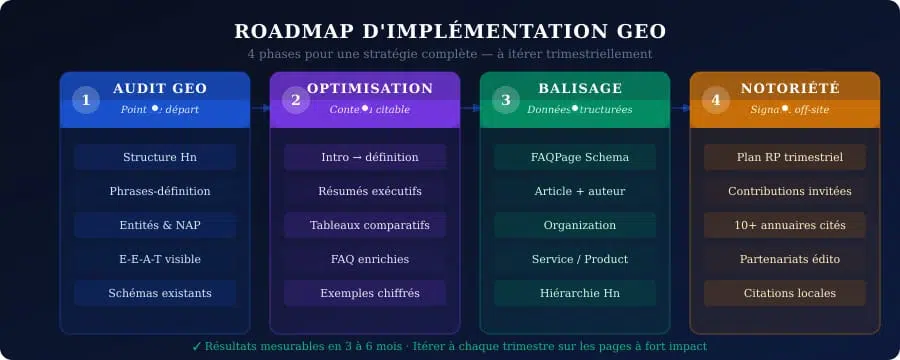
Fig. 6 — GEO implementation roadmap in 4 phases
GEO audit (starting point)
- Hn structure — does each page have a clear H1, topical H2s, and H3s for sub-points?
- Definition sentences — do introductions start with a direct definition of the topic?
- Identified entities — does the page explicitly mention your brand, your industry, your geographic area?
- NAP consistency — are name, address, and phone identical across all platforms?
- Proof of expertise — author bios, media mentions, certifications — are they visible?
- Structured data — are the appropriate Schema.org schemas implemented?
Content optimization
- Rewrite introductions — into direct definition sentences (“GEO is…”)
- Add an executive summary — at the start of each article or pillar page
- Limit jargon — or define each technical term at its first occurrence
- Include quantified examples — and structured comparisons in tables
- Create or expand FAQs — with questions phrased the way people ask AI
Semantic markup
- FAQPage — for all Q&A sections
- Article + author — with datePublished and dateModified
- Organization or LocalBusiness — with URL, logo, address, phone number
- Service or Product — with description, price if applicable, reviews
Building off-site awareness
- PR plan — 3 to 5 mentions in relevant media per quarter
- Editorial partnerships — guest contributions on authoritative industry sites
- Local citations — consistent presence in 10+ quality directories
GEO and SEO: a winning combination
Why SEO remains essential
SEO ensures discoverability, technical performance, and direct conversion. It also feeds GEO by providing already indexed, reliable, structured content that generative engines can leverage. Without strong SEO, GEO has no raw material to build on.
How to combine the two
Build pillar pages optimized for SEO (keywords, internal linking, performance) with sections explicitly designed for AI citation (definitions, FAQs, comparisons). Think topic cluster + FAQ + structured data to maximize both channels at once.
FAQ — Generative Engine Optimization
Will GEO replace SEO?
No. GEO complements SEO. Both are needed: SEO to capture direct traffic, GEO for “zero-click” visibility and early-stage influence in the buying decision.
Do you need to rework your entire site?
No—prioritize high-impact pages: pillar pages, service pages, buying guides, existing FAQs. Then iterate on secondary content.
Does GEO apply to all industries?
Will GEO replace SEO?
Do you need to rework your entire site?
Does GEO apply to all industries?
How long before you see results?
Allow 3 to 6 months to see measurable changes in AI Overviews and branded queries, depending on the initial state of your content.
Which tools can you use to measure GEO?
Google Search Console (AI Overviews), Semrush AI Toolkit, Otterly.ai, and manual tracking of mentions in ChatGPT, Perplexity, and Copilot.
How long before you see results?
Allow 3 to 6 months to see measurable changes in AI Overviews and branded queries, depending on the initial state of your content.
Which tools can you use to measure GEO?
Google Search Console (AI Overviews), Semrush AI Toolkit, Otterly.ai, and manual tracking of mentions in ChatGPT, Perplexity, and Copilot.
GEO: a structural lever
GEO isn’t a fad: it’s a structural shift in how people find information online. By combining strong SEO with content explicitly designed to be cited by AI, you protect your visibility today and prepare your presence in tomorrow’s search.
| Ready to take action? The Cassiopea.ca team can run a full GEO audit of your site and propose a prioritized action plan. |
